Sunday, 26 June 2016

EU Referendum - A time for Serenity or for Courage?

"God, grant me the serenity to accept the things I cannot change, courage to change the things I can, and wisdom to know the difference." Reinhold Niebuhr's famous prayer has been on my mind today.

In the wake of Thursday's devastating result, should we now shrug our shoulders, say 'that's democracy' and serenely accept the outcome of the EU referendum? When I look at all that blue on the map of England and Wales I am tempted to feel hopeless and ready to despair. I woke up on Friday feeling as if war had been declared, as if everything I had worked hard for all my life had gone and that my country had been taken away. I felt unnerved and destabilised as markets crashed, as I spoke to people in tears and shock, and I felt scared, aware that something very nasty has been unleashed in our society. Nothing that has happened since has reassured me or reduced my sense of grief and bereavement.

I don't feel ready for serene acceptance. I'm not yet prepared to accept that leaving the EU is the right outcome for the UK. I think this is a time for courage. 


During the Referendum campaign, with our two main political parties in disarray, no-one made a really strong case for all the positive benefits of being in the EU, notably for many of the areas with a majority in favour of leaving. A lot of people felt confused and that they didn't know the full facts. Many people who voted to leave don't seem to have understood the full implications of what they were doing. Nearly all of the promises made to them have been broken already or exposed as blatant lies.Some Leave voters are already expressing regrets. Others are engaging in racist criminal behaviour and stirring up a climate of hatred that has been festering for some time but now appears to have had the lid taken off. Our British reputation for tolerance, inclusion and openness (such as it was) may have been permanently tarnished. A recession has likely been triggered in the UK, if not globally.

This was not a General Election. The EU referendum is not legally binding. It is advisory. The advice is that we are a deeply divided nation who need clear and calm leadership and an end to deprivation and austerity. The advice is that all of our capital cities and 2 of the 4 countries of the UK do not want to leave the EU and that doing so is likely to lead to the break up of the United Kingdom. The advice is that only 37.8% of the electorate voted to leave, less than 27% of the total population, and that the young people who voted, and who will be most affected in the long term, overwhelming want to remain. We did not even allow 16 to 17 year-olds a say. The advice is that although 17.4 million people want to leave, 16.1 million don't. A difference of 1.3 million people out of a total population of 65 million is not a sufficient margin to break up our United Kingdom, wreck our economy, risk our security, throw away our rights and destroy our environment.

Please write to David Cameron and to your MP asking them to oppose the invocation of Article 50 and to vote against it in Parliament. Please write to your MEPs, EU ministers and office holders asking them to help us not to make this foolish mistake. And above all please continue to show love, tolerance and compassion towards all our fellow citizens, Leave or Remain, EU or non-EU. We are all one.

We can still step back from this. It will not be easy and it will take courage. My prayer today is that I will have the courage to continue to say to my fellow countrymen and women who voted Leave that I think they are wrong; that I will have the courage to call on our politicians to be courageous in helping us to think again; and that I will have the courage to reach out to others and invite them to believe that they too can have the courage to change things. Time alone will tell if this courage was also wisdom.


Monday, 6 July 2015

Centre Court

Here is a piece I wrote back in July 2003 when Martina Navratiliova won her 20th Wimbledon title with victory in the mixed doubles. It seems I was reading Barbara Kingsolver's High Tide in Tucson at the time, hence the apology, although I can't remember now if it refers to a particular essay in that brilliant collection. It seems appropriate to post this during Wimbledon fortnight and to celebrate the US decision to legalise same sex marriage. Now if they could only bring back serve and volley lawn tennis...

CENTRE COURT
(with apologies to Barbara Kingsolver)

I’m sitting in my friend Anne’s living-room, wearing my favourite faded black denim jeans and shiny new tan Cowboy boots. To fully admire these my feet are up on Anne’s glass-topped coffee-table. We are scoffing peanuts, swigging back Molson beer and watching the game on TV.

But the game is not the World Series or even the Superbowl, although no doubt many otherwise well-adjusted mid-life women could justifiably spend their time on either. The game we are giving up our Sunday afternoon for is being beamed by satellite over five or six thousand miles, from the sedate manicured grass lawns of the All England Croquet and Lawn Tennis Club in Wimbledon, UK.

None but diehard fans of this august institution set amid leafy London suburbs now recalls that tennis was once the Young Turk, invading the sacred lawns of SW19 with gut-strung rackets swinging fiercely against the cylinder-shaped wooden croquet clubs known as mallets. These days Wimbledon is internationally famous, one of the four Grand Slam tournaments that all tennis players dream of winning but few attain. The only one, now, that is played on grass, where the skills and tactics of serve-and-volley are barely mastered by modern players. But still they come, Young Turks and old, to try their hand on grass that has surely been cut with nail scissors.

On court is Martina Navratilova, definitely an old Turk. Nine times Ladies’ Singles Champion and holder of ten further titles in doubles and mixed doubles. Her partner, a smiling, round-faced Indian man called Leander Paes, was born the first year that Navratilova played at Wimbledon, in 1973. Then she was a mousy-haired, sixteen-year-old chubby Czech. Five years later when she won Wimbledon for the first time, beating super-cool, elegant Chrissie Evert in a three-set thriller, she was stateless, a defector, her parents huddling round a TV set near the East German border to watch their daughter’s triumph. Now the Berlin Wall is a distant memory and Navratilova is one of us, a US citizen, lithe, lean and lissom with tinted blonde locks. In crisp shorts her presence on the court is eager and efficient, like a well-bred greyhound, her competitive instincts undimmed. She wears her forty-six years lightly, like a plastic raincoat that can be discarded when the sun shines. Martina Hingis, the tennis champion who was named after her, has recently retired, aged twenty-two. Her two opponents today, Rodionova and Ram, Russian and Israeli respectively, are both more than half her age.

It is evening sunlight on Centre Court, midday in Tucson. As Anne and I settle in there is no sign that the crowd are about to drift away to car or Underground Station, even though the media-dubbed ‘business end’ of the tournament, the Men’s Singles Final, finished nearly three hours ago. They know, as we do, that a piece of history is about to unfold, served up by a middle-aged woman with a pink triangle in her racket.

In 1979 it was Navratilova who helped her then doubles partner, Billie-Jean King, to win her record-breaking twentieth Wimbledon title. The previous record-holder, Elizabeth Ryan, had prophetically died the night before. We fervently hope Billie-Jean, on the verge of her sixtieth birthday, won’t do the same as Martina lobs and volleys her way to equalling that record.

They are our heroes; two sporting women who have surpassed all expectations of our sex, pioneers of fitness, diet and dedication. But above all they have been true to themselves. Living their personal relationships in the spotlight of public attention and judgment they have let their tennis speak, not their lesbianism. Whatever that is. Women who love women, and life, and tennis.

Two sets, two more beers. As the sun descends over South-East England, Anne and I stand and cheer, raising our glasses to a legend, a modern goddess achieving her dream.


Tuesday, 9 June 2015

On Reading: Pastures of the Blue Crane by H. F. Brinsmead

I am grateful to have reacquired recently a copy of this novel, by the Australian author and environmentalist Hesba Fay Brinsmead (1922 – 2003).  The copy I had as a child got chewed up by the family dog and for ages all I could remember about the book was this beautiful cover and that it had a heroine called Ryl. Pastures of the Blue Crane was first published in 1964; this Oxford University Press edition was produced in 1970. It is Brinsmead’s most well-known work and was made into a television series for the Australian Broadcasting Company in 1969.

The novel opens in a Melbourne summer (November). Sixteen-year-old Amaryllis Jane Merewether, known as Ryl, is leaving school. She believes she is all alone in the world. Her mother is mysteriously absent and her father has long ago abandoned her into the care of his lawyer, who has acted as her guardian and placed her in a series of boarding schools. No demure heroine, Ryl is “calculating, self-centred… and yet not without flashes of charm”. Through “the judicious habit of present-giving”  she has won invites from school fellows so that she doesn’t have to remain at school during the holidays. Now her lawyer-guardian tells Ryl that her father has died and that she has jointly inherited his substantial estate with her previously unknown grandfather, Dusty. They meet for the first time in the lawyer’s office and at first sight seem an ill-suited pair. Their crusty relationship is explored as they find themselves co-owners of a farm called Bundoora in Murwillumbah, North New South Wales. It turns out that this is the place where Dusty was born and raised. On her first morning Ryl is woken by the sun and looks out to see the glittering landscape:  a ‘fanciful’ pasture of rosy pink grass crested with silver and within it a ‘fanciful’ bird – the blue crane. Dusty and Ryl have very different ideas about what to do with their property - and about spending the money they have inherited.  Through her encounters with this remote community, and ultimately her shared battle with Dusty to preserve their home, Ryl finds love, friendship, family, and her future career path, as well as discovering the truth about her parentage.  The novel’s treatment of themes related to age, race, gender and the secret shame of families is somewhat antiquated now but must have been both fresh and daring at the time.  Pastures of the Blue Crane is a well-crafted ‘coming-of-age’ novel , which casts a fascinating light on aspects of life in 1960s Australia.

Monday, 27 April 2015

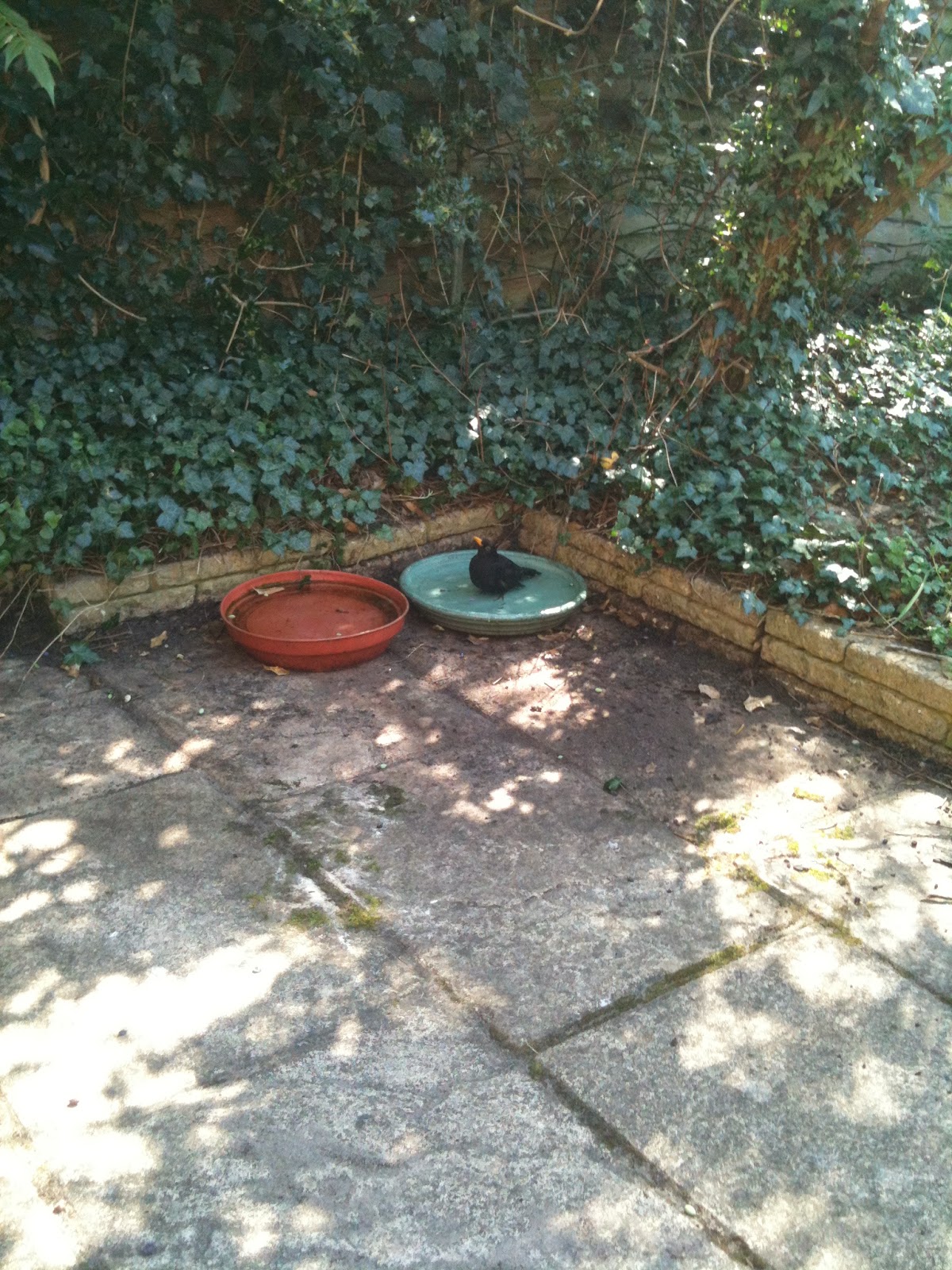
Blackbird's Prayer

Blackbird's Prayer

If you were to ask the blackbird
why she is fervently picking up sticks
from my garden this April morning
I doubt that she would answer
other than to say: And so it is,
for blackbirds.

Susanna Reece

Wednesday, 8 April 2015

Shetland Remembers: 8 April 1940


Blackboard recording events on the night of 8 April 1940
Fascinating talk this afternoon  up at the Sumburgh Head Lighthouse and Visitor Centre by archaeologist Chris Dyer, on the anniversary of the averting of a Luftwaffe air raid on Scapa Flow. The Centre has recreated the Radar Hut that detected the incoming enemy aircraft and has lots of artefacts and photographs telling the story of the scientists and military personnel who made this possible. Chris has also discovered letters sent to the Admiralty and the Northern Lighthouse Board by the Lighthouse Keeper, who was concerned about the 'militarisation' of the site and threats to civilians. The Luftwaffe raid has been described as an attempt at a British 'Pearl Harbor'. The prevention of the raid was undoubtedly due to the careful monitoring on Shetland and was an important event for Britain's defences in the early years of World War II. To celebrate the anniversary, there was also an amateur radio station set-up, complete with old radio magazines and a replica Enigma machine.

As well as the twentieth century military history, Chris talked about the archaeological features that show the use of the land at Sumburgh as an Iron Age Fort, evidence that this has long been a site of strategic importance.


Radar detection at Sumburgh Head

British propaganda poster

Replica Enigma machine
1930s radio magazines
The view from Sumburgh Head

Allan Williams Turret, Toab, Shetland

Shetland Flag flying at Sumburgh


Sunday, 5 April 2015

Easter Day: Arising

What does it mean, this resurrection story? Early in the morning it is the women who go to the tomb only to find that their Beloved is no longer there. When they give witness to having seen the Risen One, they are not believed. Yet gradually the men too are able to see. But what, or who, are they seeing? In Seeking the Risen Christa, Nicola Slee writes of her own experience of Easter Day spent with a group of women, one of whom says: "Jesus died as a Palestinian, Jewish man. Christ rises to be God with us in many different forms..." Perhaps in all forms. Including the Risen Christa. At the local airport here on Shetland there is a book exchange - today I found there a copy of The Barefoot Indian, the making of a messiahress by Julia Heywood. It spoke to me on this day of arising, an invitation to greet the Risen Christa within as well as without. In the church calendar, today marks the start of 50 days to celebrate the risen life. This is not just the life that Jesus stepped into through becoming Christ; rather it is the life in which we are all invited to participate. What will it mean for us to arise, to know the grave, bear our scars, acknowledge our own suffering and that of others; and yet remain hopeful, offering and seeking healing for ourselves and others, coming back out into the world with compassion, caring, gentleness, kindness and courage? "Alleluia, I greet the Risen Christa in you!"


Saturday, 4 April 2015

Great Saturday

This Holy Saturday between Good Friday and Easter Sunday is one of the strangest and perhaps the most forgotten day in the church year. What is this day, how should we spend it? The One whom we have loved and known has gone and will not return. The only certainty we have is that finality. We are grief-stricken, bone-tired, fearful, perhaps even terrified. Nicola Slee calls this day 'the feminist gap': a time of 'shedding one reality in order to discover something new'. Her poem The Christa of Holy Saturday describes powerfully those times when we don't want to get up, would rather stay asleep, weep, rest, remain undisturbed. The late great John O'Donohue's last book Benedictus, also has a wonderful poem called 'for the interim time', where he writes of those times in life when the path behind us has disappeared without any clear way marked ahead. Here, at this mid-point in the Easter Triduum there is an opportunity to remain deeply with our sense of loss and uncertainty, not knowing what is going to happen next or how long we will have to stay here, bereaved and vulnerable. We may be without hope, fearful that it will always be like this now. Or we may be waiting for the new with a sense of curiosity but without any idea of what it will be. Here we must rest and wait. We do not know what deep transitions and transformations may be at work behind the tomb's sealed door.